
The Golden Compass Film Review
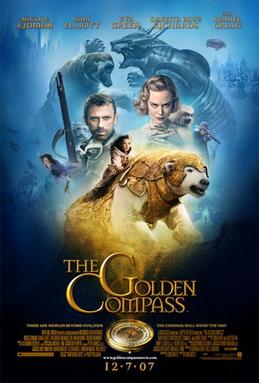
After watching recently the The Golden Compass, and expecting the worse because of Joel’s bad review, I had the pleasant surprise of finding it to be one of the best fantasy films I’ve seen.
Regardless of the movie’s mysterious nature, it is still obvious enough to understand what the story is about (a little girl in search of a family), what “dust” is (a key player in the political climate that stands between the girl and her wishes), and who the characters are… even though it doesn’t need to be obvious, due to cinema’s tradition of keeping the audience “below the line” when it comes to fantasy stories. What I mean is, with movies like Harry Potter, you (as the audience) don’t know what’s happening, yet they can still be enjoyable.
The film The Golden Compass is indeed a first act, with the introduction of many characters… but are they really that many? They are archetypical enough to make sense. And most of them have one-on-one screen time with Lyra, which facilitates the bonding process between character and audience. The most creative choice for the characters is the elimination of the usual suspects. Instead of amazons/elves, we have witches; instead of dwarves, we have gypsies; instead of rings, we have a golden alethiometer. Instead of… well, you get the picture.
The “Darth Vader/I-am-your-father” theme is present in TGC. To me, this is the most exciting part of the film, because it places a grey mantle of ambiguity over an already ambiguous story. Everyone loves a villain who is capable of feeling absolute love, a love more noble than that of the good guys. I can’t go into details because it is too much of a wonderful spoiler to give away.
The Golden Compass imitates the episodic structure of other fantasy/science fiction tales that are out there by cutting off the book’s ending in which little Lyra rescues Lord Asriel. The film suffers by this, because the audience doesn’t find enough satisfaction in having to wait a year to see the resolution. Anyone remembers LOTR’s second act is just the fellowship walking and fighting? It is too late to have the excitement of acquiring the ring, yet it is too early to conclude in the ring’s destruction. The Golden Compass’ episodic structure is not as extreme as this, but I think they could have easily added an extra half an hour of film to give the story a better resolution. We are already used to seeing this type of movie last 3 hours or more.
The visuals are simply astonishing, and the tension is held very well throughout the film, regardless of the absence of monsters. People get their fix of magical creatures with all the humanized animals present in the film. The choice of using pure CGI to convey the daemons (animal spirits) was very smart. It gave them that extra sense of ethereality needed to make them work. The concept of an animal spirit is a beautiful Native American belief, and seeing it connect with Plato’s Symposium (Zeus bolting joined souls) was a real treat. TGC cannot help but to inspire in me a longing for life with an animal spirit of my own. The biggest accomplishment? Achieving a level of maturity in the story-line, regardless of the talking animals. They could have easily made The Golden Compass infantile, yet the film didn’t lose its maturity throughout this risky situation.
I think the reason why maybe some LOTR fans or HP fans might find TGC disappointing is because *gasp* we have grown up! Omg, we are finally old. The genre is coming to a saturation. It has been 10 years of us watching these long-ass fantasy films, and maybe we are tired. We are no longer 18, and watching people with long ears and green tights is not as fun as it used to be. Other than that, I really wouldn’t see a reason why The Golden Compass is less than excellent. It will not get me as involved as I was when I was a kid, but I can still love it, and find it to be a more refined product of the fantasy boom.
The Golden Compass is a brilliant movie, and in a way it hits closer home than the Narnia tales or the Ring tales. Why is that? Because the LOTR is more of a political/anti-technology story, and Narnia is all about rewriting the Bible, while The Golden Compass focuses on the spiritual battle of the mind, and the enemy is the Church. Now, how sweet can this be? The allegories were so obvious… the actor who plays the “Pope” is simply identical to the Pope. He’s also wearing Clergy clothes. Where would someone miss the theological implications? I don’t know. But I think even with the censorship, it was obvious enough to win the hate of Christians out there.
Need any extra incentives to watch? The current Pope is boycotting the movie. So, it is our responsibility to make The Golden Compass a success. Not only because of its entertaining value, but because the message it conveys is much more noble than that of other fantasy films out there. There’s a prophecy in the film of an impending war in which the Magisterium and the revolutionaries will battle for people’s Free Will, so it simply seems ironic that actually seeing the movie is an exercise of said power. By watching, you are ensuring a future of riskier films made in Hollywood, with deeper and more controversial themes.

No Comments