
Diggin’ and Ron Paul
Lets give a warm welcome to the latest trend online: live data visualization! This is the part of our dialog that can get non-techies into throwing a fist, and techies into rolling their eyes at how “old” the technology I speak of really is. I do feel it is important to write about this as an important scientific breakthrough and social trend, since things don’t become truly relevant until they become saturated subjects. Most people I talk to are still asking me what “digg” means. Heck, people are still wondering what do you mean when you “delicious.” Notice how all of these Internet things become verbs. Will we end up saying uncool things like, “I monster. Do YOU?”
To digg is to share a story with others in a network of users who also feel that story is relevant (another form of social bookmarking); as the story becomes more relevant, the story get “bigger.” The bigger a story gets, the easier it is to be read by more people. Think about it as a system of filters that allow you to see what’s hot online as we speak. The interesting thing from a New Media perspective is what they are doing at the digg.labs, which is to represent those stories through a visual hierarchy of data visualization.
How Do You Digg?
Arc
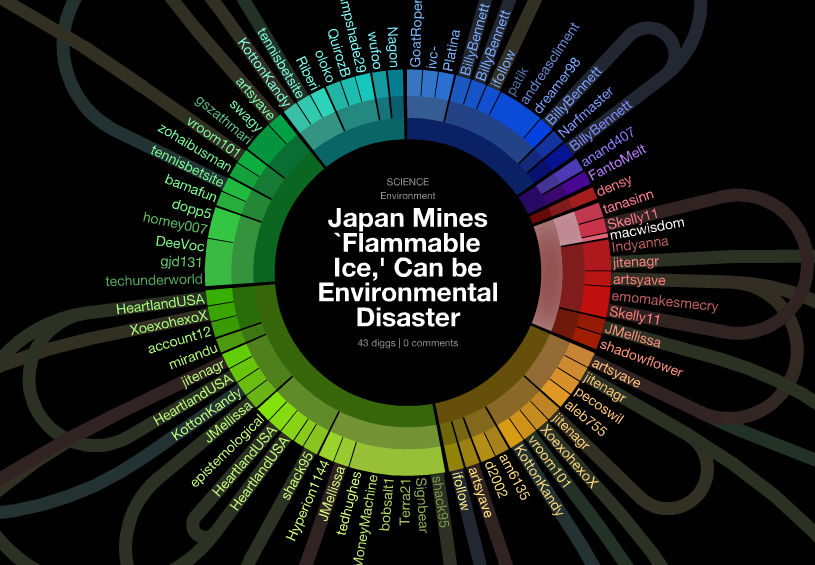
You can view your stories as an arc. This option is one of the most visually trippy. Along with the swarm option. This is the future of art and info graphics. There’s a lot of cool stuff in the works that uses “random” mathematical algorithms to make it happen. Truly the perfect marriage of engineering and art.
BigSpy
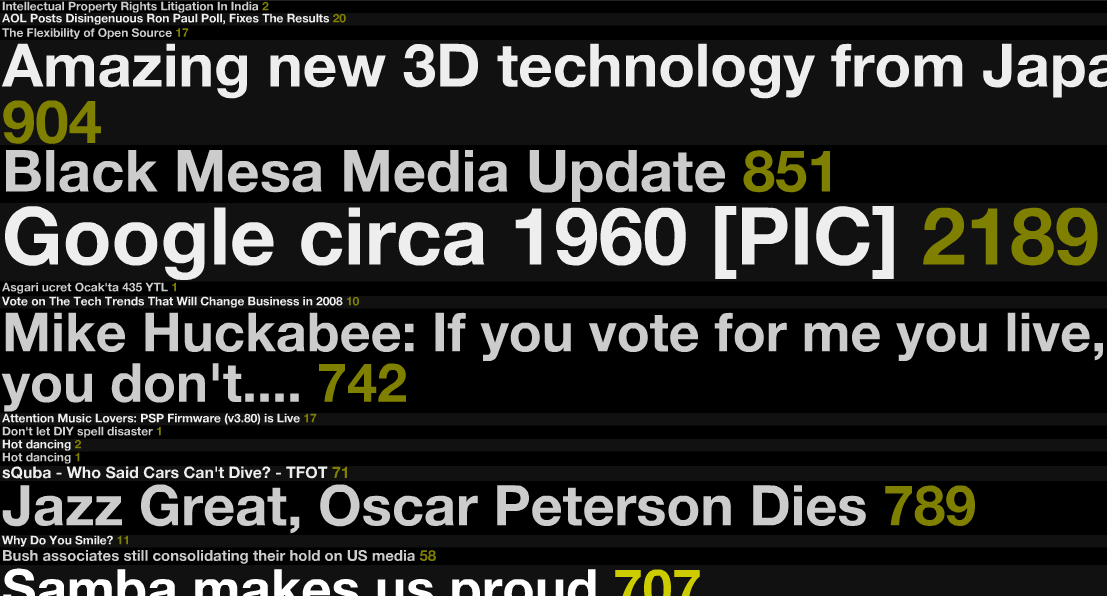
Or maybe you prefer blocks of text? Using the BigSpy option. Notice how the white text represent the titles for articles, videos, or pictures that digg users “digg.” On the left side, you’ll find the number of diggs in yellow. The more a story is plugged, the bigger it literally is. People recognize colors and sizes more easily and faster than plain old text. So, to have a people filtered system brings the power back to the user. You determine what you want to see, and what you think it is important.
Pictures
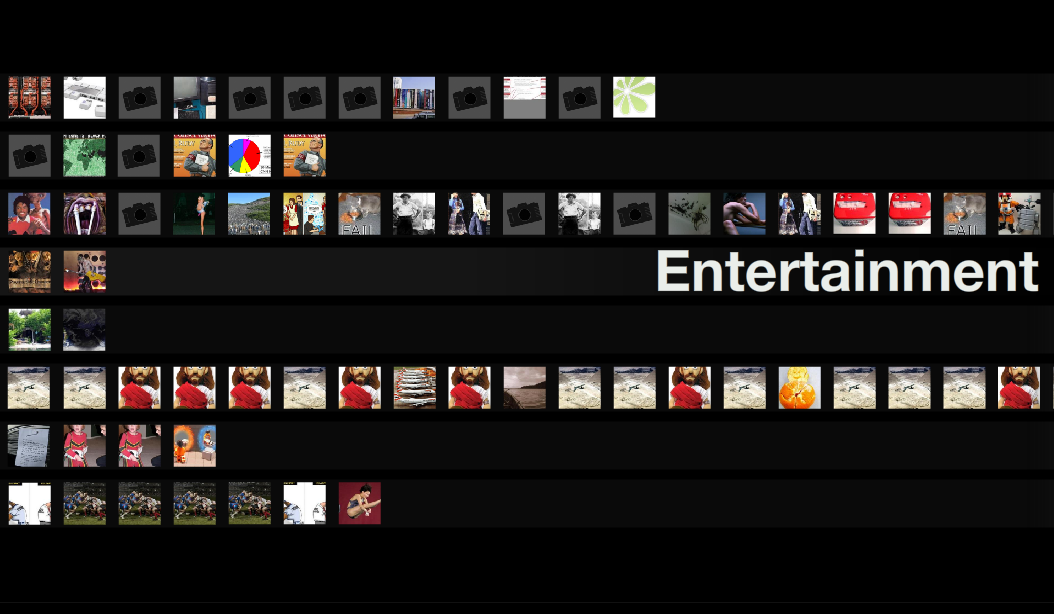
And here’s the latest. Picture visualization. The nice thing about this is the fact that you can actually divide stories by category, without leaving any category behind. It reminds me of MTV’s True Life opening sequence. Which is pretty neat, because it just shows how any rendered artwork has the potential of becoming a live template to data. Once you click on any of these squares, you are taken to the digg page that offers a brief description of what you want to see. After that, you can either go back to your trippy visualizations, or you can actually visit the link to the original article.
Political Implications
The downside to all of this is that a filtering system such as this is only as good as its users. And luckily, Digg fans are a bunch of Silicon Valley tech geeks. But what if stupid people or bots begin to use it. I’m sure the number of sane users will always outnumber the bots or the crazies, but it is a big fear to find people misusing such wonderful technology. A good example of Digg being misused is seeing how Republican candidate Ron Paul uses digg as a political platform. There’s no direct evidence to this, but every time you log on to Digg, the most digged stories are the ones relating to him. How is this unusual? Well, this is a social bookmarking website filled with users who love technology, computers, odd news, and funny things… and amidst all this “geekery,” Ron Paul’s name suddenly pops up with hundreds of diggs. If Digg would be a place where The 700 Club would be making headlines, then Ron Paul’s presence would seem perfectly believable. Ron Paul’s stories are another example of the tragedy of commons applied to the Internet. Absolute democracy opens up to absolute abuse. Don’t get me wrong, many “Ron Paul-ers” surely are not getting paid, but the fact that someone pushes an article in a community in which people want to see relevant stories, and not everything ever written on a republican, is disrespectful.
Now, talking about hidden agendas, I’m going to place Ron Paul’s name as part of the title of this article, and we’ll wait and see if what I said is true, that most “Ron Paul-ers” don’t read an article on him before actually digging it. This is both going to prove me right, and have me be digged. So, thank you Ron Paul… for having your minions catapult me to fame. See ya in hell, buddy… See ya in hell.
-Alex
P.S. Don’t forget to check out the Diggnation podcast with Kevin Rose and Alex Albrecht. They do a fun commentary about the most popular stories being dugg. I should mention that Kevin Rose is Digg’s founder, so it should be fun to see the news right from the horse’s mouth. Be sure to check it out!

Can you at least understand why Paul supporters are frustrated watching the debates? During the latest CNN debate, Paul only recieved 8.5 minutes of interview out of the entire 2 hour time. If the msm is not willing to cooperate and give him his fair slice of time, heck yeah, we’re going to use Digg to help gain him support.
And my suggestion to anybody in the Ron Paul bury brigade: Quit burying every single thing about Ron Paul without reading it first. We’ve had guys leaving disrespectful comments on digg posts for official campaign newsletters, and I’m telling you, you’re starting to get underneath peoples’ skin. If you can’t run your “Anti Ron-Paul” campaign more respectfully, you will only end up irritating people and seing more people trying to submit Ron Paul articles.